centaronline.org
 politeia.institute
 crnonabelo.com





Urgent Amendments to Judicial Laws – Bypassing the Profession and European Standards and Amounting to Political Retaliation for “Disobedience”
National Convention on the European Union (NCEU)
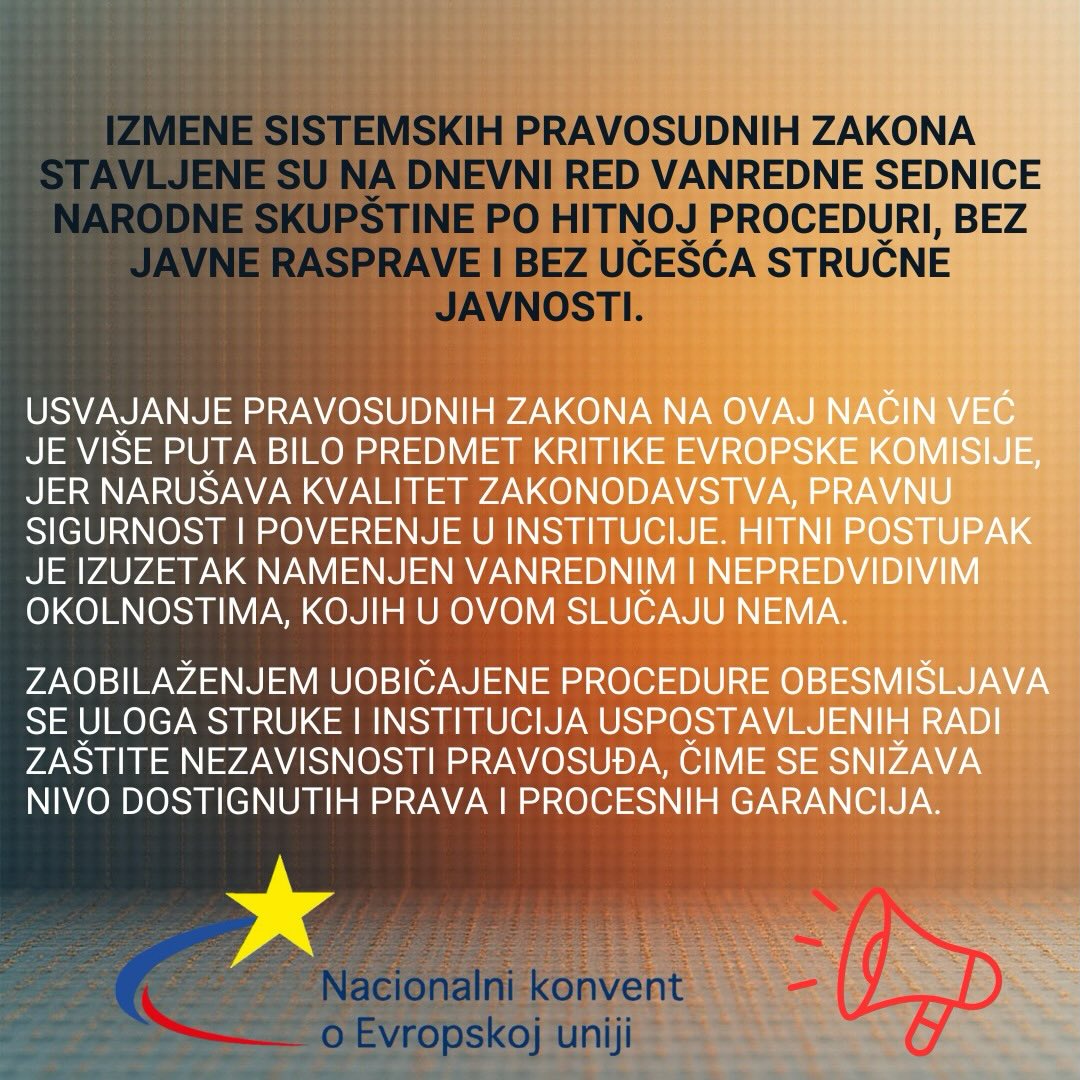
The Working Group of the National Convention on the European Union for Chapter 23 warns the public about the serious risks posed by the scheduling of an extraordinary session of the National Assembly for 14 January, at which amendments to systemic judicial laws will be considered under an urgent procedure.[1] The agenda of the extraordinary session includes the Draft Law on Amendments to the Law on the High Prosecutorial Council, the Draft Law on Amendments and Supplements to the Law on the Seats and Jurisdictions of Courts and Public Prosecutors’ Offices, the Draft Law on Amendments and Supplements to the Law on the Organization and Jurisdiction of State Authorities for Combating High-Tech Crime, the Draft Law on Amendments and Supplements to the Law on Public Prosecution, and the Draft Law on Amendments to the Law on Judges.[2]
Over the past year, reform-related laws of crucial importance for the functioning of the judiciary have not been adopted through the regular legislative procedure, due to the lack of agreement between the proponents of the laws and the legal profession. The proposed amendments continuously lower the level of previously attained rights and procedural guarantees, which is the main reason for the absence of professional consensus. The most recent example of such practice is the attempt by the Ministry of Justice to amend the Law on Judges, on which the High Judicial Council issued a negative opinion.[3] Instead of the Government, the draft laws are now being submitted by a Member of Parliament, and through an urgent procedure. This procedure is used extremely rarely and has never before been applied to systemic judicial laws, thereby undermining the role of the profession and institutions established precisely to protect the independence of the judiciary.
It is particularly important to emphasize that public debate on these significant changes was deliberately avoided by the fact that the formal proponent of the laws is not the Government, but Member of Parliament Uglješa Mrdić. Had there been a genuine intention to consult the public and the professional community, the National Assembly, namely its Committee on the Judiciary, Public Administration and Local Self-Government, chaired by Mrdić himself, could have organized a public hearing and enabled the presentation of views of both the professional and general public. Such an option, however, was clearly not in line with the objectives of the proponent.
The Working Group recalls that the adoption of judicial laws under an urgent procedure has repeatedly been the subject of criticism by the European Commission, as such practice undermines the quality of legislation, legal certainty, and public trust in institutions. The urgent procedure is an exception intended for extraordinary and unforeseeable circumstances, which do not exist in this case.
We point out that particularly problematic are those provisions relating to the extension of acting (ad interim) mandates in the management of prosecution offices and courts, as well as the abolition of the commission of the High Prosecutorial Council responsible for deciding on objections to mandatory instructions, thereby lowering standards guaranteed by the Constitution, particularly with regard to the autonomy of the prosecution service. Equally problematic is the fact that the amendments concerning the special prosecution unit competent for high-tech crime are being undertaken in order to establish control over its work, rather than to address the alleged ambiguities in the Law.
Additional concern arises from the fact that all of this is taking place at the time of the election of members of the High Judicial Council and the High Prosecutorial Council from among the profession, in an atmosphere of intensified public attacks on judges and prosecutors and protests by judicial professionals, including a protest in front of the Constitutional Court precisely in response to the announced legislative amendments. In such a context, hasty and non-transparent legislative interventions represent an inappropriate form of influence by the legislative and executive branches over the judiciary.
The Working Group of the National Convention on the European Union for Chapter 23 calls on the National Assembly to refrain from considering amendments to judicial laws under an urgent procedure and to return reform processes to a framework of transparent, inclusive, and lawful procedures, in accordance with constitutional principles and the European obligations of the Republic of Serbia.
Working Group of the National Convention on the EU for Chapter 23
Source: NCEU
[1] The Sixth Extraordinary Session of the National Assembly of the Republic of Serbia of the Fourteenth Convocation, scheduled for Wednesday, 14 January 2026, starting at 10:00 a.m.
[2] Insajder, SNS MP Uglješa Mrdić Submits Draft Judicial Laws to the National Assembly, 22 December 2025.
[3] HJC, Opinion of the High Judicial Council on the Draft Law on Amendments to the Law on Judges, 9 December 2025.


PUBLICATIONS
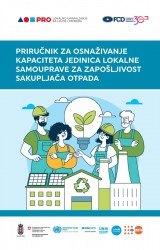 Manual for Strengthening the Capacities of Local Self-Government Units for the Employability of Waste Pickers
 NCEU Book of Recommendations 2025
 Manual “The Path to Employment: Get to Know Your Rights and Opportunities”
 Challenges for Organising and Collective Bargaining in Care, Administration and Waste collection sectors in Central Eastern European Countries
 Public Policy Proposals – Collective Bargaining (CEECAW)
 CDF in Cities and Municipalities: Together for a Better Life in Local Communities
 Comparative reports on collective bargaining - CEECAW
 POLITEIA – Regional School for Youth Participation 2025 (leaflet)
 Report on the State of Labour Rights in the Republic of Serbia in 2024
 Unlocking Collective Bargaining Power in Three Sectors: A Call to Action
 Main Issues of Labor Legislation in Serbia
 New Monitoring Report by the “SDGs for All” Platform: Is the End Goal in Sight?
 NCEU Book of Recommendations 2024 (Summary)
 National reports on collective bargaining in Serbia - CEECAW
 The Comparative Analysis of Youth Policies in the Western Balkans (WB)
 Unlocking Collective Bargaining Power in Three Sectors: A Call to Action
 Western Balkans Youth in Policy Making Processes
 SDGs for All Platform newsletter (December 2023)