centaronline.org
 politeia.institute
 crnonabelo.com





How EU Integration Can Restore the Trust of Western Balkan Youth in Democratic Institutions
Regional Youth Dialogue for Europe project
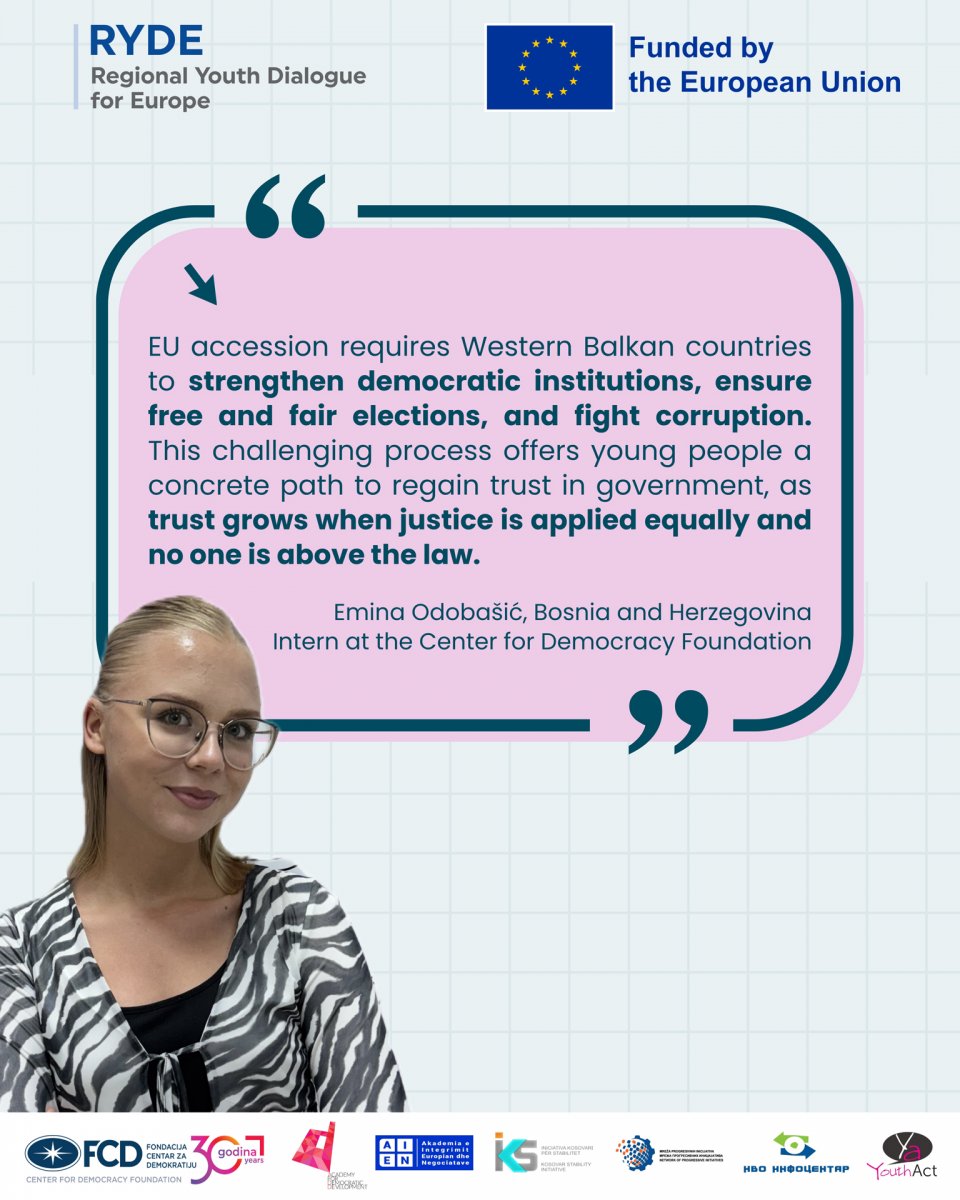
Written by Emina Odobašić, a Intern at the Center for Democracy Foundation within the Regional Internship Program under „Regional Youth Dialogue for Europe“ project, supported by European Union
During the last two decades, confidence in democratic institutions has been declining among young people across the Western Balkans. Feeling their voice does not count, opportunities are determined by corruption and political connections, public institutions do not provide equal opportunities or justice, many have grown disillusioned. Yet, amidst this overall disappointment, there is one highly shared conviction: the process of European integration can be a turning point and provide a way to rebuild the trust of youth in democracy and good governance.
The Promise of European Values
The European Union has long represented more than an economic or political alliance; it stands for a system of values: the rule of law, respect for human rights, free media, transparency, and accountability. For young people in the Western Balkans, aligning with these values is not an abstract political goal; it's a chance to live in societies where uniqueness, fairness, and equal opportunities are real.
However, these values cannot be imported overnight. EU accession requires that countries in the region strengthen their democratic institutions, hold free and fair elections, and combat corruption. This transformation takes courage and consistency, yet it's precisely one tangible path toward how young people can regain faith in their governments. That's when justice is seen to be applied equally, when no one stands above the law, trust starts returning.
Active Participation of Youth as a Catalyst for Change
Rebuilding trust also depends on the extent to which space is provided for young people to participate. Youth should not be treated as passive observers of reforms but as active contributors to the framing of policies. Through EU-funded programs, youth exchanges, and civil society initiatives, young people can engage in decision-making processes, gain experience abroad, and bring those lessons back home.
Participation means belonging. When youth participate in projects that contribute to the betterment of their local communities-through environmental actions, volunteering, or advocacy-they realize that democratic participation yields tangible outcomes. This is how trust grows: not through speeches, but through experience.
Programs like the Erasmus+, the European Solidarity Corps, and regional youth initiatives already play a significant role in this process: they empower young people to think critically, collaborate across borders, and recognize that they are part of a wider European family. Feeling included in that family may restore the belief that democracy, if genuinely applied, can work in the best interest of all.
When Democracy Delivers, Trust Follows
Trust cannot be commanded; it must be earned. Young people will only trust in institutions when they see them making a difference in their daily lives: a fair shot at education, jobs based on performance and not connections, and a system that offers incentives for hard work and ingenuity.
When democratic institutions promote a fair labor market, encourage entrepreneurship, and provide quality education, the youth can begin to feel that it is worth staying in their own country. For this reason, the process of EU integration shouldn't focus just on laws and regulations but create a fairer society that listens to its younger generations.
Transparency Through Digital Transformation
One of the most promising ways to strengthen trust is through digitalization. Indeed, transparent, accessible, and efficient public services can reduce corruption and bureaucracy, the biggest driver of frustration among young citizens.
Imagine a world where one can access all government data, apply for documents online, or track public spending in real time. Open data and digital tools can showcase the fact that institutions can be modern, efficient, and accountable; for a generation reared on the Internet, such transformation would mean governments can change with the times.
Bringing EU Integration Closer to Everyday Life
For most young people, European integration remains a distant, bureaucratic process-something that happens between politicians and diplomats, not in their neighborhoods or schools. If that is to change, then the benefits of EU integration must be visible at the local level.
Whether through renovated schools, environmental projects, or youth entrepreneurship programs, local reforms, community projects, and EU-funded initiatives should improve the lives of citizens directly. In this way, when young people can see and feel the results of EU support, they begin to associate European values with real progress and fairness, rather than with political promises.
Building Trust Through Education
Education plays a fundamental role in how young people view democracy and civic responsibility. Schools and universities need to do more than just teach facts; they should encourage critical thinking, open dialogue, and active participation in decision-making processes.
With the integration of European values into the systems of education, young people can learn what accountability, tolerance, and participation mean. It is this way that a culture of trust is developed-not with slogans, but through daily practice and example.
A Generation Ready to Believe Again
The youth of the Western Balkans are neither indifferent nor apolitical. They deeply care about justice, equality, and opportunities; they simply need proof that their institutions care back. The EU integration process gives them a framework for such proof. It gives a roadmap for countries to reform, but at the same time, it gives young people a reason to hope that democracy can work in their favor.
Trust cannot be regained overnight, but it can grow with every transparent policy, every free and fair election, and every meaningful opportunity for young people. The path toward the European Union is, after all, a path toward a more durable and trustworthy democracy-one that really serves citizens.
And that kind of Europe is the one the youth of the Western Balkans are ready to believe in, and to build.
Emina Odobašić
*The creation of this blog was funded by the European Union. Its content is the sole responsibility of the Center for Democracy Foundation and does not necessarily reflect the views of the European Union.
PUBLICATIONS
 Manual for Strengthening the Capacities of Local Self-Government Units for the Employability of Waste Pickers
 NCEU Book of Recommendations 2025
 Manual “The Path to Employment: Get to Know Your Rights and Opportunities”
 Challenges for Organising and Collective Bargaining in Care, Administration and Waste collection sectors in Central Eastern European Countries
 Public Policy Proposals – Collective Bargaining (CEECAW)
 CDF in Cities and Municipalities: Together for a Better Life in Local Communities
 Comparative reports on collective bargaining - CEECAW
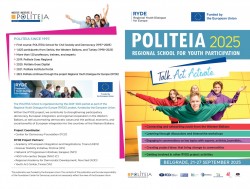 POLITEIA – Regional School for Youth Participation 2025 (leaflet)
 Report on the State of Labour Rights in the Republic of Serbia in 2024
 Unlocking Collective Bargaining Power in Three Sectors: A Call to Action
 Main Issues of Labor Legislation in Serbia
 New Monitoring Report by the “SDGs for All” Platform: Is the End Goal in Sight?
 NCEU Book of Recommendations 2024 (Summary)
 National reports on collective bargaining in Serbia - CEECAW
 The Comparative Analysis of Youth Policies in the Western Balkans (WB)
 Unlocking Collective Bargaining Power in Three Sectors: A Call to Action
 Western Balkans Youth in Policy Making Processes
 SDGs for All Platform newsletter (December 2023)